a)
f(x)=x3−3x2−24x+1
f′(x)=3x2−6x−24
Sprawdźmy kiedy f′(x)>0
3x2−6x−24>0 ∣:3
x2−2x−8>0
Δ=(−2)2−4⋅1⋅(−8)=4+32=36
x1=22−6=2−4=−2
x2=22+6=28=4
x∈(−∞,−2)∪(4,+∞)
Funkcja rosnąca dla x∈(−∞,−2⟩,⟨4,+∞)
Funkcja malejąca dla x∈⟨−2,4⟩
b)
f(x)=−3x5−5x3+30x−1
f′(x)=−15x4−15x2+30
Sprawdźmy kiedy f′(x)>0
−15x4−15x2+30>0 ∣:(−15)
x4+x2−2<0
Podstawmy x2=t
t2+t−2<0
Δ=12−4⋅1⋅(−2)=1+8=9
t1=2−1−3=2−4=−2
t2=2−1+3=22=1
t∈(−2,1)
x2∈(−2,1)
x∈(−1,1)
Funkcja rosnąca dla x∈⟨−1,1⟩
Funkcja malejąca dla x∈(−∞,−1⟩,⟨1,+∞)
c)
f(x)=x+x9
Df=R\{0}
f′(x)=1+x29′⋅x−9⋅x′
f′(x)=1−x29
Sprawdźmy kiedy f′(x)>0
1−x29>0 ∣⋅x2
x2−9>0
(x−3)(x+3)>0
x∈(−∞,−3)∪(3,+∞)
Funkcja rosnąca dla x∈(−∞,−3⟩,⟨3,+∞)
Funkcja malejąca dla x∈⟨−3,0),(0,3⟩
d)
f(x)=(x−1)2x4
Df=R\{1}
f′(x)=(x−1)4(x4)′(x−1)2−x4⋅((x−1)2)′
f′(x)=(x−1)44x3(x−1)2−x4⋅(2(x−1))
f′(x)=(x−1)44x3(x2−2x+1)−x4⋅(2x−2)
f′(x)=(x−1)44x5−8x4+4x3−2x5+2x4
f′(x)=(x−1)42x5−6x4+4x3
Sprawdźmy kiedy f′(x)>0
(x−1)42x5−6x4+4x3>0 ∣⋅(x−1)4
2x5−6x4+4x3>0 ∣:2x2
x3−3x2+2x>0
x(x2−3x+2)>0
Δ=(−3)2−4⋅1⋅2=9−8=1
x1=23−1=22=1
x2=23+1=24=2
x(x−1)(x−2)>0
x∈(0,1)∪(2,+∞)
Funkcja rosnąca dla x∈⟨0,1),⟨2,+∞)
Funkcja malejąca dla x∈(−∞,0⟩,(1,2⟩
e)
f(x)=x+3x2+5x+5
Df=R\{−3}
f′(x)=(x+3)2(x2+5x+5)′(x+3)−(x2+5x+5)(x+3)′
f′(x)=(x+3)2(2x+5)(x+3)−(x2+5x+5)⋅1
f′(x)=(x+3)22x2+6x+5x+15−x2−5x−5
f′(x)=(x+3)2x2+6x+10
Sprawdźmy kiedy f′(x)>0
(x+3)2x2+6x+10>0 ∣⋅(x+3)2
x2+6x+10>0
Δ=62−4⋅1⋅10=36−40=−4
∀x∈R\{−3} x2+6x+10>0
Funkcja rosnąca dla x∈(−∞,−3),(−3,+∞)
f)
f(x)=x+2(x−1)(x2−1)
f(x)=x+2x3−x−x2+1
f(x)=x+2x3−x2−x+1
Df=R\{−2}
f′(x)=(x+2)2(x3−x2−x+1)′(x+2)−(x3−x2−x+1)(x+2)′
f′(x)=(x+2)2(3x2−2x−1)(x+2)−(x3−x2−x+1)⋅1
f′(x)=(x+2)23x3+6x2−2x2−4x−x−2−x3+x2+x−1
f′(x)=(x+2)22x3+5x2−4x−3
Sprawdźmy kiedy f′(x)>0
(x+2)22x3+5x2−4x−3>0 ∣⋅(x+2)2
2x3+5x2−4x−3>0
Wyznaczmy miejsca zerowe wielomianu W(x)=2x3+5x2−4x−3
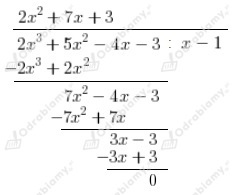
W(x)=(2x2+7x+3)(x−1)
Δ=72−4⋅2⋅3=49−24=25
x1=2⋅2−7−5=4−12=−3
x2=2⋅2−7+5=4−2=−21
W(x)=2(x+3)(x+21)(x−1)
2(x+3)(x+21)(x−1)>0 ∣:2
(x+3)(x+21)(x−1)>0
x∈(−3,−21)∪(1,+∞)
Funkcja rosnąca dla x∈⟨−3,−2),(−2,−21⟩,⟨1,+∞)
Funkcja malejąca dla x∈(−∞,−3⟩,⟨−21,1⟩