a)
x→3limf(x)=x→3limx−32x2−5x−3=x→3limx−32(x+21)(x−3)=
=x→3lim(2x+1)=2⋅3+1=6+1=7
f(3)=7
Zatem funkcja f jest ciągła w punkcie x=3.
Obliczenia:
2x2−5x−3=0
Δ=(−5)2−4⋅2⋅(−3)=25+24=49
x1=2⋅25−7=4−2=−21
x2=2⋅25+7=412=3
2(x+21)(x−3)=0
b)
x→−1limf(x)=x→−1limx+13x3+7x2+5x+1=x→−1limx+13(x+1)2(x+31)=
=x→−1lim(3(x+1)(x+31))=3⋅0⋅(−1+31)=0
f(−1)=0
Zatem funkcja f jest ciągła w punkcie x=-1.
Obliczenia:
3x3+7x2+5x+1=0
Zauważmy, że jednym z rozwiązań powyższego równania jest x=1, ponieważ:
3⋅(−1)3+7⋅(−1)2+5⋅(−1)+1=3⋅(−1)+7⋅1−5+1=−3+7−5+1=0
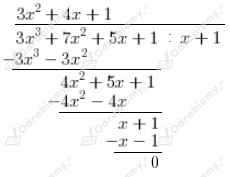
(x+1)(3x2+4x+1)=0
Δ=42−4⋅3⋅1=16−12=4
x1=2⋅3−4−2=6−6=−1
x2=2⋅3−4+2=6−2=−31
(x+1)⋅3(x+1)(x+31)=0
3(x+1)2(x+31)=0
c)
x→5limf(x)=x→5limx2−10x+252x2−11x+5=x→5lim(x−5)22(x−21)(x−5)=
=x→5limx−52(x−21)=x→5limx−52x−1
Obliczamy granice jednostronne.
x→5−limx−52x−1=5−52⋅5−1=0− 9=−∞
x→5+limx−52x−1=5−52⋅5−1=0+9=+∞
Zatem funkcja f nie jest ciągła w punkcie x=5.
Obliczenia:
2x2−11x+5=0
Δ=(−11)2−4⋅2⋅5=121−40=81
x1=2⋅211−9=42=21
x2=2⋅211+9=420=5
2(x−21)(x−5)=0
d)
x→−4limf(x)=x→−4limx2+5x+4x2−x−20=x→−4lim(x+4)(x+1)(x+4)(x−5)=
=x→−4limx+1x−5=−4+1−4−5=−3−9=3
f(−4)=3
Zatem funkcja f jest ciągła w punkcie x=-4.
Obliczenia:
x2−x−20=0
Δ=(−1)2−4⋅1⋅(−20)=1+80=81
x1=21−9=2−8=−4
x2=21+9=210=5
(x+4)(x−5)=0
x2+5x+4=0
Δ=52−4⋅1⋅4=25−16=9
x1=2−5−3=2−8=−4
x2=2−5+3=2−2=−1
(x+4)(x+1)=0
e)
x→0limf(x)=x→0limx29+12x2−3=x→0limx29+12x2−3⋅9+12x2+39+12x2+3=
=x→0limx2(9+12x2+3)9+12x22−32=x→0limx2(9+12x2+3)9+12x2−9=x→0limx2(9+12x2+3)12x2=
=x→0lim9+12x2+312=9+12⋅02+312=3+312=612=2
f(0)=2
Zatem funkcja f jest ciągła w punkcie x=0.
f)
x→1limf(x)=x→1limx−112+4x2−4=x→1limx−112+4x2−4⋅12+4x2+412+4x2+4=
=x→1lim(x−1)(12+4x2+4)12+4x22−42=x→1lim(x−1)(12+4x2+4)12+4x2−16=
=x→1lim(x−1)(12+4x2+4)4x2−4=x→1lim(x−1)12+4x2+44(x2−1)=
=x→1lim(x−1)(12+4x2+4)4(x−1)(x+1)=x→1lim12+4x2+44(x+1)=12+4⋅12+44⋅(1+1)=
=12+4+44⋅2=16+48=4+48=88=1
f(1)=1
Zatem funkcja f jest ciągła w punkcie x=1.